Wayfinding our way into the future
"Adaptation is the act of bending a structure to fit a new hole. Evolution, on the other hand, is a deeper change that reshapes the architecture of the structure itself – often producing more holes for others.
Every worker dabbling in artificial evolution has been struck by the ease with which evolution produces the improbable. Evolution doesn’t care about what makes sense; it cares about what works!" Tom Ray, Out of Control by Kevin Kelly, page 340
Historically, wayfinding refers to the techniques used by travelers over land and sea to find relatively unmarked and often mislabeled routes.
Since we are traveling into an unknown future, a good wayfinding process can help us decide when, how, and where to go. It can help us find unmarked and often mislabeled routes deep into future opportunities, perhaps helping us avoid treacherous paths and dangerous assumptions. Wayfinders help mark the way for others to follow.
Creating a Clue-Based Curriculum
CLUE: ORIGIN late Middle English : variant of clew . The original sense was [a ball of thread] ; hence one used to guide a person out of a labyrinth (literally or figuratively).
I watch my two-year old grandson, Owen, pick up clues. That is how he learns, everyday, every moment. His life is discovery and feedback. He explores, by trial and error, tries again and succeeds or fails. He watches for clues from others ... facial expressions, body language ... and then he repeats until he grasps and understands and incorporates it into his behavior or rejects it as something not useful at the moment. He also sends me clues. He engages me in make-believe stories. Since his language is still Oweneese, which I sometimes cannot understand, he gives clues by taking my hand and showing me. Owen is quite bright and capable but I don't think he understands the word "answer" yet. Hopefully as he grows and creates his own life, he will come to know that there are answers for a few things like 2+2 is 4, but for most of his life he will continue looking and connecting clues as he journeys forth into the vast unknown.
Learning is both fast and slow. Facts are fast and can be tested in the present moment; slow is a long journey, absorbing and digesting facts within a much longer time span. Slow is carried forward by context and the ability to connect clues along the way. Slow delights in discovering more, in reshaping one's facts throughout the course of life. Facts remembered can save lives in the moment.(redcross learning, calling 911, seeking safety in a tornado). Fast and slow learning is essential to the well-prepared mind. Unfortunately, too much of today's education for all ages seems to be on fast fact learning. Given this focus, how many facts are immediately forgotten after only a short period? Fast to learn; fast to forget. Since the slow is not immediately measureable, it does not seem to have as much credibility. Taken together, however, the fast and slow weave together bonding facts with context and learning by doing... learning through life.
Instead of answers, clues
In her recent post, A world without answers, Gail expounds on one of the effects of increasing rates of change and growth in complexity: Answers aren't what they used to be. So how then, as we venture into panarchy, can we utilize the incredible expertise time has accumulated, if not for answers?
An effective process through which to put "expertise" is a syntopical reading. Most often (in my experience), this is done in groups, with each person having different books or source material, and taking an hour or 90 minutes to scan and note. However, it can also be an enlightening way of thinking and engaging with ideas as an individual.
Create a dialogue with and among the authors. Don't limit them to analysis and critique - let them imagine and galumph with each other's thoughts. Use syntopical reading as a means of getting familiar with someone's ideas and the all important context and situations they rest upon... and then carrying them forward. Engage both imaginative, play-of-mind thinking as well as analytical and critical thinking.
Don't set your sights on answers. Rather, seek out clues, and explore the relationships that connect them.
I'm using syntopical reading and conversing in this way in a current exploration of paradigm shifts and other kinds of phase transitions. Gail and I recently crafted a paper touching on paradigm shifts in general but more particularly, exploring current history for compelling signs that a significant shift is unfolding, and may be on the verging on a global upcreation to borrow a term from Kevin Kelly.
A World Without Answers
"The Swarm master coaches, 'Loosen all attachments to the sure and certain.'"
Kevin Kelly, Out of Control, Hive Mind, page 25
It used to be we could rely on answers. If we did not know the answer, we could ask our parents, or a teacher, consultant, expert, the government, etc. All of our lives we have passed or failed tests because we knew or didn't know the right answer. We competed, climbed to the top of our class or corporate ladder and got tenure because we published answers that gave instruction to others.
The deeper I get into complexity science the more I come to know that looking for answers is often a hinderence to my learning. Complexity is about processes and patterns and these are recursive, iterative and adaptive! I do feel like Alice must have felt at times. How do I know what I know? Where am I on the certainty level?
"'It was much pleasanter at Home,' thought poor Alice. 'when one wasn't always growing larger and smaller, and being ordered about by mice and rabbits. I almost wish I hadn't gone down that rabbit hole..."
Alice in Wonderland, Lewis Carroll
Run-Walk-Run
"The impossible has a kind of integrity to it which the merely improbable lacks."
Douglas Adams, The Long Dark Tea-Time of the Soul
One of my favorite MG Taylor axioms is "You can't get THERE from HERE but you can get here from there." Backcasting has become popular over the years but when we first used it with our clients in 1980. It seemed very strange - and powerful - to them. Work walls to work big on? Collaboration across all boundaries, both vertical and horizontal? Unleashing Group Genius? These were things our clients had never thought about, let alone experienced. There was no proof in our beginning, no benchmarking. We simply had to put our concept to work.
RUN-WALK-RUN is a process we used on ourselves when we founded MG Taylor Corporation and put into place methods and tools that were not available in the market place. R-W-R is the process of leaping out into the future and envisioning a world that could be - well beyond what you know to be possible from the vantage point of here or today. Between THERE and HERE there are many possibilities. What is known that could help us realize our vision? One example of this was our need for large write on walls as we were sure that working big was a critical tool in enabling deep collaboration. No walls could be found. Possible vendors stared at us like we were crazy. So we made the walls ourselves by finding a manufacturer of refrigerators and getting access to the surface materials on refrigerators. One weekend with a rented truck, colleagues, and Matt's artistic imagination and engineering skills, we created our first Working Big environment of at least 20 four wide by 6 high panels.
We invited friends into the space and asked what to do with the space. Draw, create, share ideas, work together were the responses. Our walls were covered with ideas and plans. Because we had created a tiny part of our vision and been willing to share it, others were able to engage with us. In a single afternoon of working together, one office supply store owner wanted to put his furniture in the space as a showcase. Others had ideas for how to make the environment work better. We were off and running, learning as we went.
WALK signifies what isn't to be found and needs to be made up from scratch -- something that can fill in while waiting for someone to invent it.
Resilience
"The combination of fast and slow components makes the system resilient, along with the way the differently paced parts affect each other. Fast learns, slow remembers. Fast proposes, slow disposes. Fast is discontinuous, slow is continuous. Fast and small instructs slow and big by accrued innovation and occasional revolution. Slow and big controls small and fast by consrtraint and constancy. Fast gets all our attention, slow has all the power. All durable dynamic systems have this sort of structure; it is what makes them adaptable and robust."
- Brian Eno as quoted in The Clock of the Long Now by Stewart Brand
Resilience is something I want to understand better. It is an interesting word and weaves throughout our conversations whether they are focused on health, ecosystems, economies, communities, chemistry, engineering, businesses or design.
Last year I thought about my body's resilience while undergoing surgery and chemo therapy. Resilience is defined as the ability to bounce back from major shocks and in the process become stronger, more adaptable. Cancer kills and chemo therapy kills cancer. Is my body strong enough to take this double whammy? Will it bounce back stronger than before cancer? Perhaps. I can't rush it though. There is a lot of slow taking place. I have good days, good weeks, I feel solid again and then something puts the brakes on and slows me way down and says "Not so fast". My doctors and nutritionist tell me I have another six to eight months to go before my body has woven itself back together, before slow stops nagging me with sudden nerve pains, falls, headaches, and tiredness. Fast makes multiple trys over time to assert itself so that I feel I can do anything! It's interesting because the fast and slow parts of my essence don't seem to be working together. How do I come to know my body's resilience? Is it a matter of just biding time, eating right, exercising and sleeping well?
Following the Paradigm Shift
A Paradigm Shift is when a significant change happens - usually from one fundamental view to a different view. In most cases, some type of major discontinuity occurs as well.
Thomas Kuhn wrote about Paradigm Shift during the early 1960s, and explained how "series of peaceful interludes punctuated by intellectually violent revolutions" caused "one conceptual world view to be replaced by another view."
In laymen terms, Paradigm Shift is a popular, or perhaps, not so popular shift or transformation of the way we Humans perceive events, people, environment, and life altogether. It can be a national or international shift, and could have dramatic effects -- whether positive or negative -- on the way we live our lives today and in the future. Compiled by Carol Ann Bailey-Lloyd
All of the MG Taylor models are recursive and fractal in nature. The models can be applied at many different levels. While the model of the creative process is most often used at an individual or enterprise level, it equally applies to a global paradigm shift. In 1979 when Matt and I brought our ideas and visions together to create MGTaylor, we started tracking the evolution of what we then were calling the Information Economy. We were watching the birthing of a new science paradigm being formed from quantum physics, cybernetic systems, and complexity science. We watched ideas begin to spread outside theoretical papers and move into more lay-science articles and magazines. Authors began taking the work of these scientists and working them into adjacent fields and into everyday technology. Metaphors began to appear to help ordinary folks like me come to know at least a sense of what was forming. Some religions and science began thinking together, coming full cycle with universal ideas. One early book I can remember is The Tao of Physics. In 1990, Danah Zohar wrote The Quantum Self, a landmark book for me. Suddenly the 1990s were rich with books and stories. Two of my favorites are Out of Control, by Kevin Kelly, and Leadership and the New Science by Meg Wheatley. I draw on these books continuously.
This Moment in Time
"In the market, language grew. Became bolder, more sophisticated. Leaped and sparked from mind to mind. Incited by curiosity and rapt attention, it took astounding risks that none had ever dared to contemplate, built whole civilizations from the ground up."
The Cluetrain Manifesto, 2000
Matt and I created MG Taylor, inc. in 1979 for the purpose creating a new way of working that would facilitate individuals and enterprises escaping from the existing paradigm to another. Generally, new paradigms are escapes from a system no longer functioning, to a higher order. We were hopeful, optimistic, and naive as to how long and hard the old paradigm could hold on and constrain new organizing patterns.
With our mission in hand, we went forth as a for-profit business wondering if we could put our ideas and ethics into the market place and be profitable. Over the years we facilitated many good events and worked with clients on their stickiest problems. No one was interested in paradigm shifts however. Whether for profit or not, it was all about near term, bottom-line scarcities and/or profits. 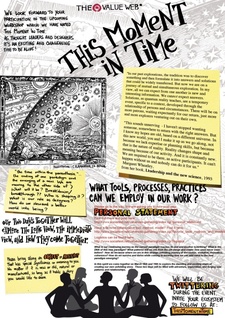 This month that changed. I had the opportunity, in collaboration with The Value Web, to design and facilitate a workshop called This Moment in Time.