
Navigating in a Networked Economy: Value Webs Reach a Tipping Point
"A network economy does not think in supply chain terms or in departmental boxes. It thinks and acts as a web of ideas, people, processes, markets, tools, environments. The parts and the whole grow stronger together. Threads weave together, forming new patterns, new connections, new capabilities. Producers, customers, and investors design, invent, build, market and sell as an ecosystem.
"Co-creation replaces the linear way of thinking and doing where each part gets it 'right' and passes it to the next part to get it 'right' who passes it on and so forth. ValueWeb communities work concurrently, changing 'hats' where appropriate, competing, cooperating ... constantly evolving to bring higher order solutions, people, and opportunities into the web." - Gail Taylor, 1998
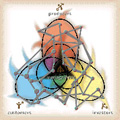 A decade ago I was introduced to a conceptual model of the networked enterprise that is now referred to as the "Value Web" model. Matt Taylor had been actively working with it and introducing it to MG Taylor clients since the 80's, but for the first time, executives and organizational leaders were beginning to embrace it. Today, in a world more fully immersed in the flows and fluidities of the networked economy, value web-like structures are becoming a mainstream means of organizing and getting things done. In the ongoing evolution and learning of how we organize and work together, this way of working is gaining fitness fast.
In essence, what I am suggesting here is that the idea of a "value web" has, after multiple tries – with each result feeding back into and changing the idea – escaped to a higher order. Whether its with the well-known, well-chronicled Big Ideas such as Open Source, P2P and Web 2.0, or any of a vast array of less publicized but equally compelling experiments, value webs have moved from "model" to "paradigm" – a new way of seeing reality.
Multiple Trys Over Time
In assembling complexity, the bounty of increasing returns is won by multiple tries over time. As various parts reorganize to a new whole, the system escapes into a higher order.
— Ilya Prigogine
Remember those times where you share your excitement about a 'new' idea with your colleagues or clients and they look you in the eye and say, "We tried that once and it didn't work." All the enthusiasm drains out of your body as you see the door closing to the unfolding of a new possibility. Sometimes people just can't stop talking about why it won't work as they base everything on a single try.
Structure wins. Paradigms are strong. They are created to maintain a structure, to create boundaries, to provide certainty to reality. Imagine if every idea was accepted and given form and authenticity! Perhaps we would all be living in Alice's wonderland! ... a good story, but maybe not an everyday, everywhere way of living that any of us could sustain.
Every solution, no matter how good or reasonable, fails overtime. It gives way to a higher order, a new solution more fit for the times and learnings of the past.
The Starfish and The Spider
"Put people in an open system and they will automatically want to contribute."
- the sixth principle of decentralization in The Starfish and the Spider by Ori Brafman and Rod A. Beckstrom
The Starfish and the Spider is a new book that adds to the growing body of knowledge about leadership, collaboration, and emergent organizational design. The bi-line is The Unstoppable Power of Leaderless Organizations. To me, this book speaks of Sapient Leadership. The book is interesting because it reinforces the reality that design, creativity and collaboration are natural to human beings. It compliments our own Value Web model.
I speak of my experience with young children in my blog on Group Genius. What the authors of the Starfish and the Spider reinforce is the natural tendency of people to play ... to tinker with ideas, to find a difference, and to add to the stockpile of ideas. Indeed, it seems to me that examples in the book are child's play ... Wikipedia, E-bay, Internet, P2P sharing, open source, etc. ... wonderful child's play!
Shifting to a Creative Economy
Over the last twenty-five years, there have been a number of overlapping descriptors of the economic systems in which businesses live. Regional and global economies have moved through the Industrial, Informational and Knowledge Economies to the Network, and now into the Creative Economy. All of these shifts have been rapid and each has incorporated and built upon – but certainly not eliminated – the previous ones.
So begins a Shift Paper that Tomorrow Makers published earlier this year in preparation for our workshops at Davos and which has drawn considerable interest and engagement since. Though we published it as a pdf, we realize it becomes much more useful as a living document, with which to engage our collective thinking...
This shift paper is written not as a wrong way/right way to think about and do business, but rather as a way to have a dialog about our assumptions and ways of working in order to increase our fitness for the kinds of situations, decisions and responsibilities that a Creative Economy imposes on us.
In this spirit, we thought it would be fun to list the "emerging patterns" of organization we identified in the shift paper, using them as a source from which to link to ideas, conversations, illustrations and other examples of these patterns in the world around us. Some of these may be familar to you, but hopefully we've uncovered a few new discoveries, as well.
Emerging Attractors for Escaping Communities
Structural coupling, then, is the process through which structurally-determined transformations in each of two or more systemic unities induces (for each) a trajectory of reciprocally-triggered change. This makes structural coupling one of the most critical constructs in autopoietic theory. -Encyclopedia Autopoietica
I have been thinking about the structural coupling processes that help create and define a community.
Of all the elements and relationships of elements that make up a community at any given time, those with the greatest attraction tend to produce the strongest coupling behavior. Which elements are the strongest at any given time is dynamic. Some elements and relationships of elements have appeared as strong coupling agents for hundreds or thousands of years. Others grow strong and dissipate with more fluidity.
At times, a new coupling agent or a new relationship among agents emerges and the social structure of the community undergoes a phase change -- a perturbation in which a new (relatively) stable-state is achieved.
Sapiential Leadership
"The task decides, not the name, the age, or the budget of the discipline, or the rank of the individual applying for it. Knowledge, therefore, has to be organized as a team in which the task decides who is in charge, for what, and for how long." ~ Peter Drucker
I have written and spoken much about group genius over the past 40 years. I have told stories about how "my" second graders taught me a lot about what I came to call group genius. Almost by accident—certainly, not by anything I learned in the school of education—I learned how much more effective teaching and learning flows "from the ground up". I had been teaching about six months when one of my students, Seth, asked a question about why soap bubbles had colors. (This was long before the Internet). My first thought was to remind him that his question had nothing to do with what I was teaching. I was getting frustrated with teaching; it seemed so many of the young minds were closed, dormant, not interested in learning. But, instead of reprimanding Seth, I said, "I don't know". And I turned to the other students and said, "Do any of you have questions you wonder about?" Eyes turned away from the windows toward me, hands shot up in the air. I don't remember it being gradual or hesitant. I remember that moment being full of life and energy.
Group Genius
"There is a central quality which is the root criterion of life and spirit in a man, a town, a building, or a wilderness. This quality is objective and precise, but it cannot be named. The search which we make for this quality, in our own lives, is the central search of a person, and the crux of any individual person's story. It is the search for those moments and situations when we are most alive."
..."This quality in buildings and in towns cannot be made, but only generated, indirectly, by the ordinary actions of the people, just as a flower cannot be made, but only generated from a seed." – Christopher Alexander, The Timeless Way of Building
Christopher Alexander's work has moved far beyond his field of architecture. I did a google of "Quality Without a Name" and noted that there are 13,000 references to it. References span across many industries and sources... each defining the essence of what it means to bring something more than can be known from the parts of a body of work or knowledge. Recently, I read Eugene Kim's blog where he defines—or attempts to—the Danish word Hygge and compares it to Quality Without A Name. Eugene provides this interpretation: "Hygge denotes a sense of intimacy and closeness, and is often used to describe gatherings of people, where you share a sense of familiarity and fun with those around you. Think 'hug,' but not as wishy-washy. It's a sense of wholeness that comes from being around others, and there's a strong association with the space that helps create this wholeness." Eugene calls this "high performance collaboration." I call it Group Genius.
Must be present to win
"The poet Rilke asks, Why are we here? Why do we have to be human? And he answers: '. . . because truly being here is so much; because everything here apparently needs us, this fleeting world, which in some strange way keeps calling to us. Us, the most fleeting of all.' Everything living gives and receives according to its nature and its possibilities. What specifically is a human being designed to give—to others and to the earth itself? In a culture dominated by money and by the principle of personal gain, could there arise a wholly realistic way of giving and serving beyond the clichès of altruism and hidden fears for our own safety or the opinions of others? What could Rilke mean by speaking not just of our 'being here,' but of truly being here? Is there a quality of awareness that is itself something we receive as a gift, and is there a quality of awareness that we can give to our world without needing to take anything?" -Jacob Needleman, Money and the Meaning of Life, pp. xxi, 1991
Shopping at my local Trader Joe's last weekend, I caught a glimpse of a t-shirt that offered me the title of this journal entry:
Must be present to win
Now there is a useful re-minder, I thought to myself with a smile and a nod. I've no idea of the particular cause or context of the t-shirt slogan. It is, of course, a play on the all too familiar message, "need not be present to win," embedded in the inescapable daily barrage of advertisements, promotions and giveaways that fill our air waves, television screens, and mailboxes (both electronic and snail).
Well, you may not need to be present to win that classic Stratocaster with whammy bar, the six-piece stainless steel fondue set, or the 5-night / 6-day all inclusive Vegas vacation, but when it comes
to recognizing the sublime in everyday experience;
to walking in new shoes and creating new experiences;
to understanding our role in the emergence of an unfolding future;
to learning and making meaning of the world ...
for these, present we must be.
Where Do Ideas Come From?
"That very night in Max's room a forest grew and grew and grew until his ceiling hung with vines and the walls became the world all around." Maurice Sendak, Where the Wild Things Are.
Children's books are subtle. I believe that each of us is born with an inherent creativity and longing to make a contribution to our world. But often, those around us—parents, teachers, businesses, society—with good meaning, conspire to rid us of this creativity. Adults seem all to eager to turn children into productive, serious, on-track-grown ups. But, authors of childrens' books have a trick up their sleeve. They embed ideas into wonderful stories ... stories that as children, we ask for over and over again. Marice Sendek is such an author. Sendak is the kind of author that won't let children forget what they inherently know.
Children's books are subtle. I believe that each of us is born with an inherent creativity and longing to make a contribution to our world. But often, those around us ... parents, teachers, businesses, social norms ... with good meaning, conspire to rid us of this creativity... these ideas that we long for and turn us into productive, serious, on track grown ups. Authors of childrens' books have a trick up their sleeve. They embed ideas into wonderful stories ... stories that as children, we ask for over and over again. Marice Sendek is such an author. Sendak is the kind of author that won't let children forget what they inherently know.
Turn Around Sam
"Anyone can talk to a tree but not everyone can carry on a conversation because they will not stay still for long enough. Sometimes it takes a whole day for a tree to tell you its name." Tokien
Joanna Macy speaks of the great turning... our turning away from a world no longer working to something more fit, more thriving for all those who are part of Universe, and in particular, Gaia, our Earth planet. In my day to day life, it is difficult to see the changes happening ... the great turning in the becoming. Rather, I keep wondering when it will begin. And then I think of Turn Around Sam one of the many characters in Tom Robbins' Skinny Legs and All. In the book, Turn Around Sam is a living statute that turns around so slowly that no one can see him move, yet move he does turning in a complete circle several times a day... everyday in a New York park.