
Undressing in Public
The only valid test of an idea, concept or theory is what it enables you to do. MG Taylor Axiom, 1983
I sometimes stare at the clothes worn by people throughout the ages and wonder what the motive was for such costuming. Corsets, pettycoat hoops around the feet, shoes that bind and distort, armour so heavy that one could hardly walk... and on and on. In the 1920's, Helen Willis, one of the world's greatest tennis players was the first to question the need for long dresses and corsets when playing tennis. She dared to undress in public by trading her dress for mid calf pants of a sailor type style. Follow swimming suits fashion through the ages and you will find the same questioning over time about the appropriate dress for the situation. And over time, new images of what is appropriate dress comes into fashion.
Today, another form of undressing in public is happening. This time it is not about clothes but about expertise. For years and years, we have sought to get our doctorates or other certificates signifying that we have the answers ... that our answers out-trump other answers.
3 AM
"If you did not do what you did today, for example, the entire world would be in some way different.
Your acts ripple outward in ways that you do not understand, interacting with the experience of others, and hence, forming world events. The most famous and the most anonymous person are connected through such a fabric, and an action seemingly small and innocuous can end up changing history."
Jane Roberts, The Nature of the Psyche: It's Human Expression, 1979
Michael Ventura wrote a book about the 60's and 70's called Shadow Dancing in the USA. One of the concepts that fascinated me is his believing that many of us are awake at 3 AM in the morning ... wondering, worrying, playing with ideas, intuiting and creating our future. At a gathering with some of my friends in Point Arena and Gualala, I shared this thought and from here an idea took form. Anne Kessler took the lead and has organized a really fun event. On April 1, 2007 we are hosting the first of what we think might be many...
WHAT DREAMS KEEP YOU UP AT 3 AM?
Do you have an idea, a dream, a project, a vision? Our dynamic community is filled with brilliant and creative people whose ideas and projects will totally amaze you! Do you have a project that is community minded, or a plan for a business, or just a really wacky idea? Could you use some help? Would you like to let people know what you are thinking?
Creating A Cultural Shift
"People don't resist change. They resist being changed."
—Peter Senge
Since the premier of the WorkSpace at the World Economic Forum 2005 Annual Meeting, it has hosted well over 50 sessions and workshops, traveled from the Alps to Egypt and South Africa, and brought several thousand participants into an unprecedented depth of collaboration and co-design. From climate change to the creative imperative, ending chronic hunger to ending intellectual property rights, tribal dynamics to information epidemics, WorkSpace sessions have taken on issues that touch about every individual, community and society on the planet.
Individually, many of these sessions have been a highlight of participants' experience, and have done as much as any other session to shape the Forum's annual agenda. More importantly for the Forum, the cumulative impact of the WorkSpace has been a cultural shift within the Forum community.
Communication
O civili, si ergo,
Fortibus es in ero!
O nobili, deis trux.
Vatis enim, causan dux.
A very savvy communicator told me the following story. He was part of a 50 person group and they were in the 3rd of a five day process. The group was divided into five ten person teams and each team was asked to select a word .... any word. His group chose "love". Once they chose their word they were asked to independently write ten words that expressed "love" for them ... synonyms for love. Then they were asked 1) to guess how many words they had in common and 2) to compare their words and discover how accurate their guess was. The group guessed that out of 50 words they had at least 10 in common. It turned out they had three!!! Three common words describing love!
I later tried this and the word our group settled on was "empowerment". We had two words in common!
Conversations
“The time has come,” the Walrus said,
“To talk of many things:
Of shoes—and ships—and sealing wax—
Of cabbages—and kings-
And why the sea is boiling hot—
And whether pigs have wings.” - Lewis Carroll
This coming Wednesday evening, twelve of us from the Redwood Coast (Mendanoma) are having a conversation. We don't all know each other but we have one thing in common: we are hungry for real conversations. We're out of practice. We know how to instigate projects and fight battles. We know how to be against things and for things, but really we don't know the art of conversation.
In preparation I have just finished reading a book named: Conversation: How Talk Can Change Our Lives by Theodore Zeldin. "Conversation is a meeting of minds with different memories and habits. When minds meet, they don't just exchange facts: the transform them, reshape them, draw different implications from them, engage in new trains of thought. Conversation doesn't just reshuffle the cards, it creates new cards."
Our first conversation will revolve around "What is conversation?" I guess this is a bit like an Escher design of his Drawing Hands.
What new cards will be created as our Redwood Coast community instigates and practices conversation? What stories and ideas will unfold? What difference will this small effort make over time?
2007 - Cycles Unfolding and Enfolding
"...This sounds unnerving -- I haven't stopped wanting someone, somehow to return with the right answers. But I know that my hopes are old, based on a different universe. In this new world, you and I make it up as we go along, not because we lack expertise or planning skills, but because that is the nature of reality. Reality changes shape and meaning because of our activity. And it is constantly new. We are required to be there, as active participants. It can't happen without us and nobody can do it for us. Meg Wheatley, Leadership and the New Science, 1993
As the calendar turns from '06 to '07, I wonder, does a new year matter? And what is this measure we call 'time'? Keeping time goes back in time ... maybe almost as far back as humans do. Until recently, time was seen and experienced not a linear progression, but as cycles, continuously repeating yet always new. The word commencement signifies endings and beginnings. I like this. December 31st may be an artificial ending and January 1st an arbitrary beginning, but it commands (for me) reflection, digestion, exploration, reframing, ending, or letting go to make room for new emergent explorations.
Finding Unseen Messages
Our imagination is stretched to the utmost, not as in fiction, to imagine things that are not really there, but just to comprehend those things that are there. Richard Feynman, The Character of Physical Law
I get a kick out of my MacMail message as it searches for new emails. "Finding unseen messages" seems so easy for it to do. Within seconds it either reports that there are no new messages or that I have something in my "in box." How I wish my mind could work like this! Einstein's comment: "The only thing that interferes with my learning is my education" certainly holds true with me. How is it that we become so trapped by our assumptions and what we have been told as truth that we often fail to see what is right in front of our face? I wish I had a reset button that would take help me see what's in my inbox ... differently!
Quotes as Design Agents
"In those places where we're most alive, we are questions, not answers. These questions change as we age. One has to listen carefully, again and again, to detect new questions, which may announce themselves in a whisper. At any age, the questions we're asking define our growing edge. So long as we've got even a single question, we're not dead. If all we have are answers, we might as well be." Robert Fuller, Somebodies and Nobodies: Overcoming the Abuse of Rank
I am often invited to provide quotes to people or for an event. I love quotes. Note that each of my Journal entries begins with a quote. Each reminds me that I am not alone in my thinking; there are others musing over similar challenges and insights... I have hundreds of quotes and each is an instruction or insight for me. They are far more than words; they are ideas to build on and to take as instructive commands. They give added voice to my own thinking or to that of a group. I can remember many of the moments where "words jumped off the page" and introduced themselves to me. Sometimes I have been lucky enough to meet the authors and thank them for their gift. Sometimes, the authors have been surprised and delighted with my insights into their words. I have added meaning they never considered! Good exchanges between author and myself bring forth even more meaning.
Navigating in a Networked Economy: Value Webs Reach a Tipping Point
"A network economy does not think in supply chain terms or in departmental boxes. It thinks and acts as a web of ideas, people, processes, markets, tools, environments. The parts and the whole grow stronger together. Threads weave together, forming new patterns, new connections, new capabilities. Producers, customers, and investors design, invent, build, market and sell as an ecosystem.
"Co-creation replaces the linear way of thinking and doing where each part gets it 'right' and passes it to the next part to get it 'right' who passes it on and so forth. ValueWeb communities work concurrently, changing 'hats' where appropriate, competing, cooperating ... constantly evolving to bring higher order solutions, people, and opportunities into the web." - Gail Taylor, 1998
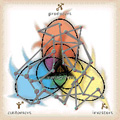 A decade ago I was introduced to a conceptual model of the networked enterprise that is now referred to as the "Value Web" model. Matt Taylor had been actively working with it and introducing it to MG Taylor clients since the 80's, but for the first time, executives and organizational leaders were beginning to embrace it. Today, in a world more fully immersed in the flows and fluidities of the networked economy, value web-like structures are becoming a mainstream means of organizing and getting things done. In the ongoing evolution and learning of how we organize and work together, this way of working is gaining fitness fast.
In essence, what I am suggesting here is that the idea of a "value web" has, after multiple tries – with each result feeding back into and changing the idea – escaped to a higher order. Whether its with the well-known, well-chronicled Big Ideas such as Open Source, P2P and Web 2.0, or any of a vast array of less publicized but equally compelling experiments, value webs have moved from "model" to "paradigm" – a new way of seeing reality.
Multiple Trys Over Time
In assembling complexity, the bounty of increasing returns is won by multiple tries over time. As various parts reorganize to a new whole, the system escapes into a higher order.
— Ilya Prigogine
Remember those times where you share your excitement about a 'new' idea with your colleagues or clients and they look you in the eye and say, "We tried that once and it didn't work." All the enthusiasm drains out of your body as you see the door closing to the unfolding of a new possibility. Sometimes people just can't stop talking about why it won't work as they base everything on a single try.
Structure wins. Paradigms are strong. They are created to maintain a structure, to create boundaries, to provide certainty to reality. Imagine if every idea was accepted and given form and authenticity! Perhaps we would all be living in Alice's wonderland! ... a good story, but maybe not an everyday, everywhere way of living that any of us could sustain.
Every solution, no matter how good or reasonable, fails overtime. It gives way to a higher order, a new solution more fit for the times and learnings of the past.